Transforming Patient Flow at Countess of Chester: A Digital Dashboard Revolution
At a recent Proud2bOps “lunch and learn” webinar, Dan Wadsworth, Director of Strategic Accounts at TeleTracking UK, and Dave Hall, Discharge Facilitator, Countess of Chester Hospital NHS Foundation Trust, showcased how digital dashboards are revolutionising bed management and patient flow in NHS hospitals. Their focus: practical, data-driven improvements in patient discharges and real-time hospital operations.
TeleTracking, the integrated operational platform for patient flow, supports hospitals by enhancing bed management, discharge planning, porter moves, and other logistical operations. With increasing pressure on NHS resources and no additional bed capacity, leveraging technology to maximise efficiency has become more important than ever.
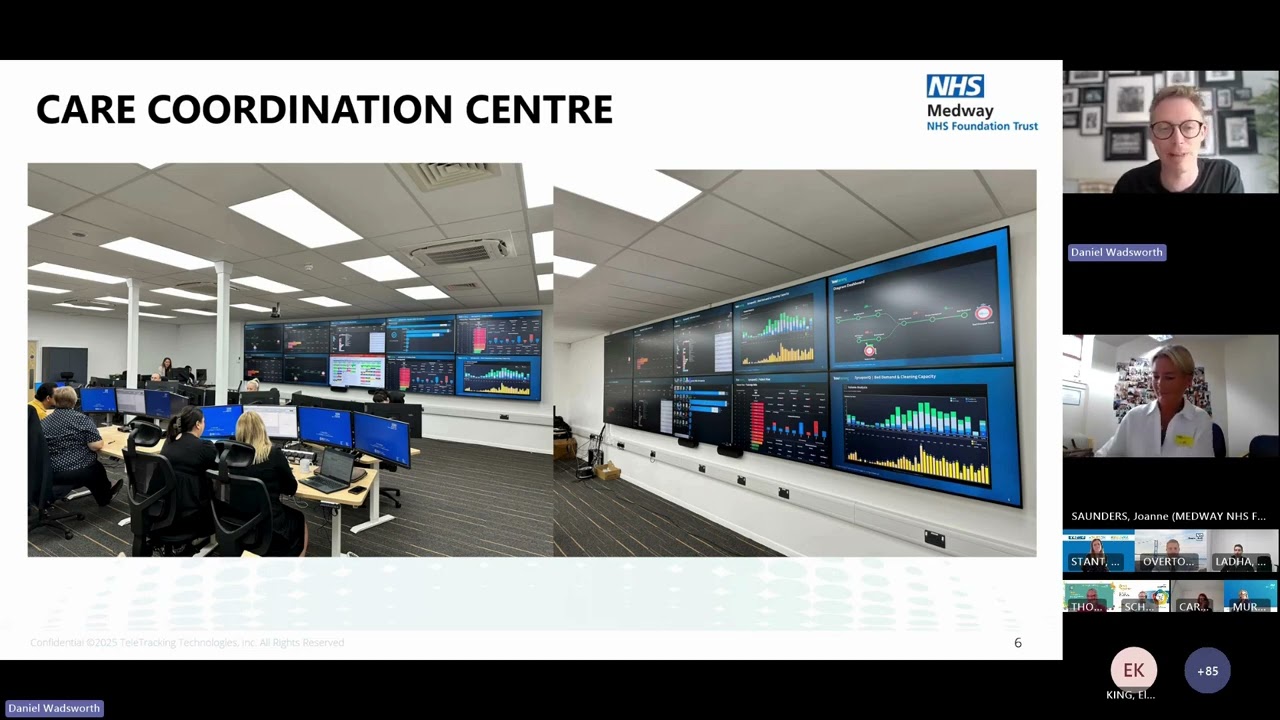
At the Countess of Chester, TeleTracking operates across both the main hospital site and a rehabilitation unit in Ellesmere Port. The Trust’s clinically led Coordination Centre, where Dave facilitates discharges & flow, handles 100 bed requests daily, including new admissions, internal transfers, and elective pathways. With a discharge profile of around 60 patients a day, the challenge of placing the right patient in the right bed—on time and safely—requires precision and speed.
One of the biggest gains has come from digital dashboards that offer real-time visibility into patient status and bed availability. Previously, the team relied on a static, clunky spreadsheet to track discharges. Today, that has evolved into an intuitive, data-rich dashboard offering insights into ward-level discharge activity, discharge lounge availability, and live porter and bed-cleaning updates. This advancement has shaved hours off daily workflows, reduced delays, and improved communication between departments.
A standout feature is the auto-discharge function. Patients wear RFID-enabled badges that trigger an automated update when dropped into a designated box, turning the bed “dirty” in the system and triggering cleaning workflows up to three hours earlier than traditional methods. This visibility is crucial to meeting the growing demands of emergency departments and avoiding backlogs at the front door.
“The Coordination Centre now operates three daily capacity meetings to set discharge priorities, escalate bottlenecks, and assign porter teams more effectively,” Dave comments. A central “move should be done” dashboard shows in real-time which wards can immediately accommodate patients from ED. This allows the team to free up critical beds during peak times and quickly respond to ambulance arrivals.
“A major focus has been on reducing internal transfer times—now sitting at 73 minutes—towards a target of under 60 minutes. External transfers from ED are already averaging 55 minutes, exceeding the one-hour benchmark,” he adds.
Further innovations are coming. The team is working with TeleTracking to track discharges for the following two days, not just the current day. Plans are in motion to automatically populate dashboards with attributes from the Trust’s Cerner Millennium EPR, such as whether a patient is awaiting medication (TTO), diagnostics, or has been referred to the discharge lounge. This level of foresight could make next-day discharge planning significantly more proactive.
The synergy between technology and operations at the Countess of Chester is a model of modern NHS efficiency. As Dan Wadsworth notes, “What’s been achieved in patient flow and discharge visibility is having real impact.”
For trusts navigating constrained capacity and rising patient demand, the message is clear: data-driven coordination isn’t just a nice-to-have—it’s essential for safe, efficient care delivery.